Exhibition Artwork
Organic Worlds: Symbiogenesis in Art was an exhibition of art about biology understood from the perspective of context, collaboration, and coupling. It focused on the artwork of Ken Rinaldo and Amy Youngs, each of whom engages organisms living together. The word “organic” is shorthand for two things: organisms and organicism. The exhibition incuded art that engages living organisms across scales, from bacteria to worms to whales to the humongous fungus Armillaria solidipes living in the Oregonian forest. It also referenced the parts-whole philosophy of organicism. Modern art movements such as Constructivism, the Bauhaus, and Surrealism engaged holist organicism during the early twentieth century, manifesting its skepticism of mechanical reductionism in a careful dance between abstraction and the figure. In contemporary art it materializes in interspecies and bio-art and science in the form of niche construction theory, ecological evolutionary developmental biology (eco-evo-devo), epigenetics, and the organism-and-environment instead of organism-versus-environment perspective of situated genetics. The contemporary eco-conscious art of Rinaldo and Youngs gives new shape to organicist biology, as it collectively takes the organism-and-environment instead of organism-versus-environment perspective of expanded epigenetics – or, cellularly, environmentally, and culturally situated genetics.
The exhibition explored the manifold organic worlds inside and outside of living bodies through the individual practices of Rinaldo and Youngs, and how bio-art and interspecies art create physical and metrical knowledge about the complexities of environmentally situated biology. Exhibition artworks included two-dimensional works and time-based media that involved sound, touch, smell, immersion, amplification, and magnification. Rinaldo and Youngs do not resist or reject biology and biotechnology in their art, but rather, embrace and braid them into new ways of learning through play. Their art reveals organisms evolving themselves collaboratively with human technology for better and worse.
- Dr. Charissa Terranova, Curator

Detail of Sounds from the Subterrarium (2024) by Amy Youngs
Photo Courtesy of Fatemeh Baigmoradi
**The following descriptions were provided by the artists and accompanied the artwork in the exhibition.
Rootscan, 2026
Amy M. Youngs and Ken Rinaldo
Medium: Installation with dried roots, twine, bamboo, laser scanner, sensor, motor, and Arduino.
The complexity of entangled plant roots offers a beauty almost too much to take in all at once. A laser light illuminates their details. Are the roots communicating? No… but yes, they were.
Living roots develop intimate relationships with fungi, bacteria, soil organisms, and other plants. Charles Darwin wrote that the roots of plants are like a brain, because they are sensitive to their environment and they make decisions. These show up as dynamic - however slow - changes in where to move and how to direct overall plant growth. This “root-brain” hypothesis has been advanced by scientists today, who are uncovering the chemical signals that plant roots are using to communicate. They are defining the new field of plant neurobiology.
The roots in this sculpture come from extra vigorous plants weeded from our yard, dead plants found abandoned in our neighborhood alleyways, and culled plants from the biological sciences greenhouse at our university.

Rootscan by Amy Youngs and Ken Rinaldo
Photo Courtesy of Fatemeh Baigmoradi

Video Courtesy of Amy Youngs

Flesh of the Sun by Amy Youngs
Photo Courtesy of Amy Youngs
Flesh of Sun, 2025
Amy M. Youngs
Medium: video installation with paper, bamboo, and cordage made of day lily leaves.
Experiencing sunlight with plants connects my plant-fed animal body with their sun-fed flesh.
A phone camera helps me pay attention to the plants in front of me, despite the noise of people, cars, birds, and planes. My hand guides my own focus as well as the focus of the camera. The “intelligence” of a smartphone is trained to privilege people and moving subjects, not plants. A hand in the frame helps direct the algorithm as it calculates the focal point.
The dappling effects produced by plants shadowing the sun are simulated with perforation patterns on the surface of the screen.
Anicca Antennae: Soil as Brain, 2020-2026
Ken Rinaldo
Medium: Interactive installation with sound of four custom autonomous robots with antennae, artificial intelligence, machine vision, environmental sensors being controlled by a living soil ecosystem, isopods and springtails.
Materials: Soil bacteria, fungal communities, Mac Mini, glass terrarium, acrylic, aluminum, stainless steel, microcontrollers, 4K Osbot web-camera, sensors, infrared LED array, speakers, power supplies, network hardware, low light palm plant, water, Milk back isopods, springtails, laser-fabricated robotic components, rapid prototypedplastic, carpet, wiggle wood barrier, motors, and two flat screen TVs.
Within a living terrarium, unseen worlds become audible, visible, and strangely familiar. Soil, microbes, springtails, isopods, plants, and autonomous robotic beings enter into a shared conversation, each shaping the others' behavior. Tiny movements beneath the surface ripple outward into gestures of light, sound, and motion as AI-driven antenna robots act as extensions of the ecosystem itself. Here, intelligence is not housed within a single organism or machine but emerges from countless relationships—between bacteria and roots, insects and soil, code and matter, life and technology. The installation invites us to imagine the soil not as inert ground beneath our feet, but as a vast, distributed mind whose thoughts unfold through the labor of innumerable living beings a form of emergent consciousness.
Named after the Buddhist concept of Anicca, or impermanence, the work embraces continual transformation. Populations rise and fall, moisture shifts, microbes bloom and recede, insects wander, and the robots respond in an endless cycle of becoming. No state is fixed; no participant remains unchanged. The machines do not dominate this
ecology but listen to it, joining a chorus of biological and technological voices that together compose an ever-changing environment. In this delicate hybrid world, boundaries between organism and artifact begin to dissolve, revealing a poetic vision of life as a network of mutual dependencies—an evolving symphony where soil dreams through insects, robots become avatars of microbial worlds, and technology emerges not as separate from nature, but as one more expression of Earth's ongoing creativity.
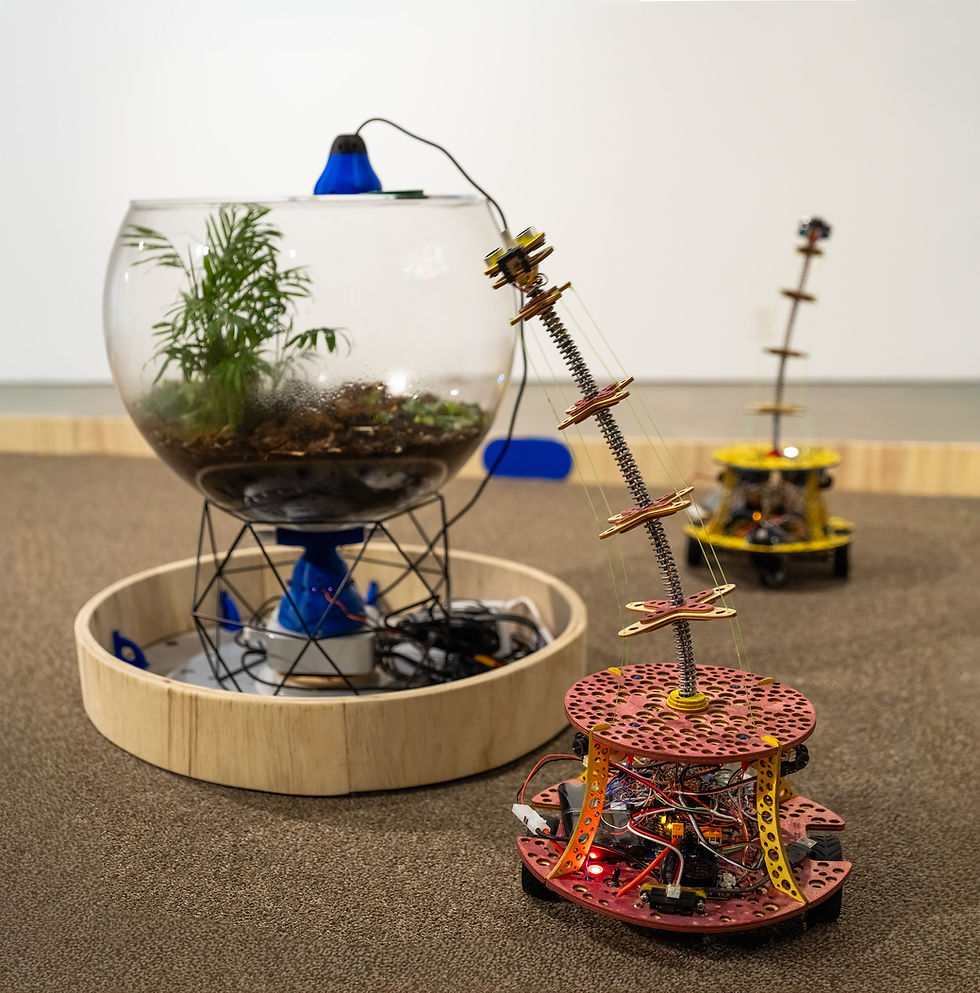
Annica Antennae: Soil as Brain by Ken Rinaldo
Photo Courtesy of Fatemeh Baigmoradi

Video Courtesy of Ken Rinaldo

Mobile Soil Maker by Amy Youngs
Photo Courtesy of Fatemeh Baigmoradi
Mobile Soil Maker (webcam upgrade), 2026
Amy M. Youngs
Medium: Sculpture with live composting ecosystem, live webcam, ipad, upcycled wood and fabric sculpture, garden cart, worm castings.
This hybrid composting ecosystem—home to red wiggler worms and isopods—is a colony I have kept for over thirty years. We have shared many meals: I feed them my household and studio waste, and the fertilizer they produce nourishes my houseplants, herbs, and garden tomatoes.
To celebrate these soil critters, I converted a worm‑bin sculpture into a wagon with a webcam. Detritivores work in the dark. They do not announce their role in mitigating climate change by processing food waste without methane emissions, nor do they speak about circulating nutrients and healthy soil microbes. I’m sharing this on their behalf because I hope others will develop regenerative relationships with composting ecosystems.
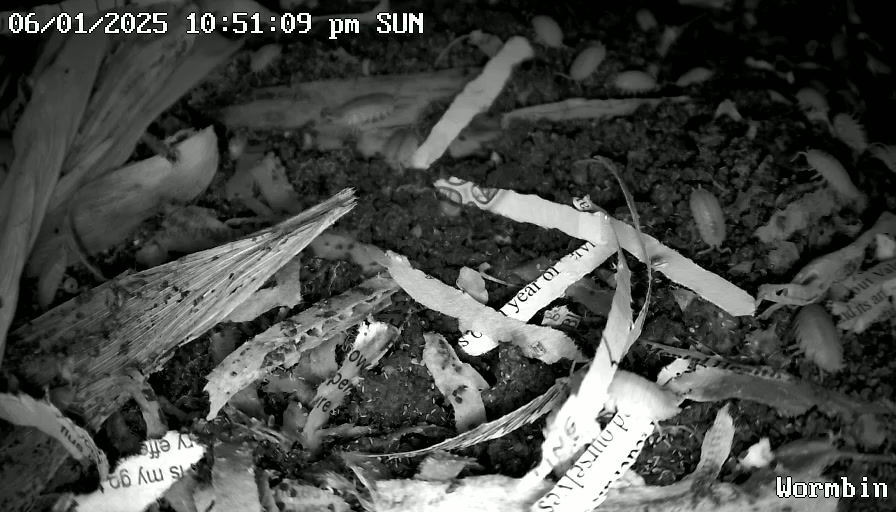
Time-Lapse Video Courtesy of Amy Youngs
Here is the news from earth:
Life is not life
Science is not science
Mind is not mind
Look at it from space
Where time is out of joint
Where there is no day or night
Or rather there is day-night, night-and-day at the same time
Daylight and shadow, the blinding sun and the simultaneously
Sobering and hallucinatory reality of distant and receding stars**
Look at Earth from out there
It is not everything. It grows humble. It is half-lit, majestic.
This is the place. This is the time.
Earth is not Earth. It is blue. It grows pale and plain as you recede.
It disappears.
Like the face of the beloved lost in the crowd
Was it ever there? More there than when the
Lights dim and she becomes Beauty itself—
A pale perfect shape, sweet face of her
Nude promise concealed and illuminated by the EXIT sign
Life is not life
It is written in the script of the universe
Like Coca Cola in Arabic
An interrupted promise
What in magic we call the one-ahead principle
Even the cosmonauts will tell you
The men who have set foot on the Moon
Who have gotten off the unhijacked Space Shuttle
They will tell you that when you are in orbit
Going around the Earth every 45 minutes or so
There is no day or night, no up or down
Sun rise follows sunset very quickly
The light cuts through the thin ribbon of the atmosphere
Illuminating the interior of the capsule with all the colors of the rainbow
Then, 45 minutes later, night falls
Earth becomes the place where there are no stars
By Dorion Sagan
Earth
Symbiogenesis, 2025–26
Ken Rinaldo
Symbiogenesis explores the evolutionary event that transformed simple bacterial life into the complex cells that make all plants, animals, insects, and humans possible. More than two billion years ago, independent microorganisms entered cooperative relationships, eventually becoming the mitochondria that power nearly every cell on Earth. Seven illuminated glass mitochondrial forms communicate through light, sound, and energy exchange. Two additional vortex interactive sculptures are part of this installation, as is a rocket ship, and printed proteins also hang from the ceiling, as does a single SIGN artwork.
Medium: Interactive installation with glass and robotic sculptures, electronics, living plants, insect and shrimp cultures, AI-generated voices, microscopes, mosses, projected imagery, vortex’s, projections, and networked sensing systems.
Symbogenesis by Ken Rinaldo

Sagan Mitochondria by Ken Rinaldo

Succulent and Cactus Mitochondria by Ken Rinaldo
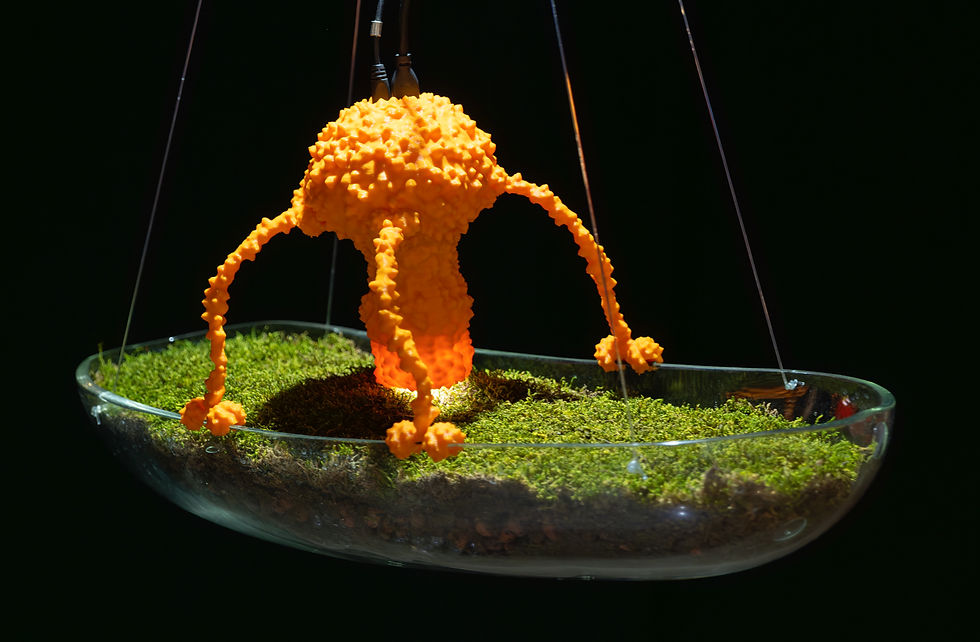
Moss Mitochondria by Ken Rinaldo

Fern Mitochondria by Ken Rinaldo

Cherry Red Shrimp Mitochondria by Ken Rinaldo

Isopod Mitochondria by Ken Rinaldo

Water Mitochondria by Ken Rinaldo

Human Vortex by Ken Rinaldo
The Evolution of Information is Life by Ken Rinaldo

The United Planet, or More-than-Human Others by Ken Rinaldo
Image Courtesy of Ken Rinaldo


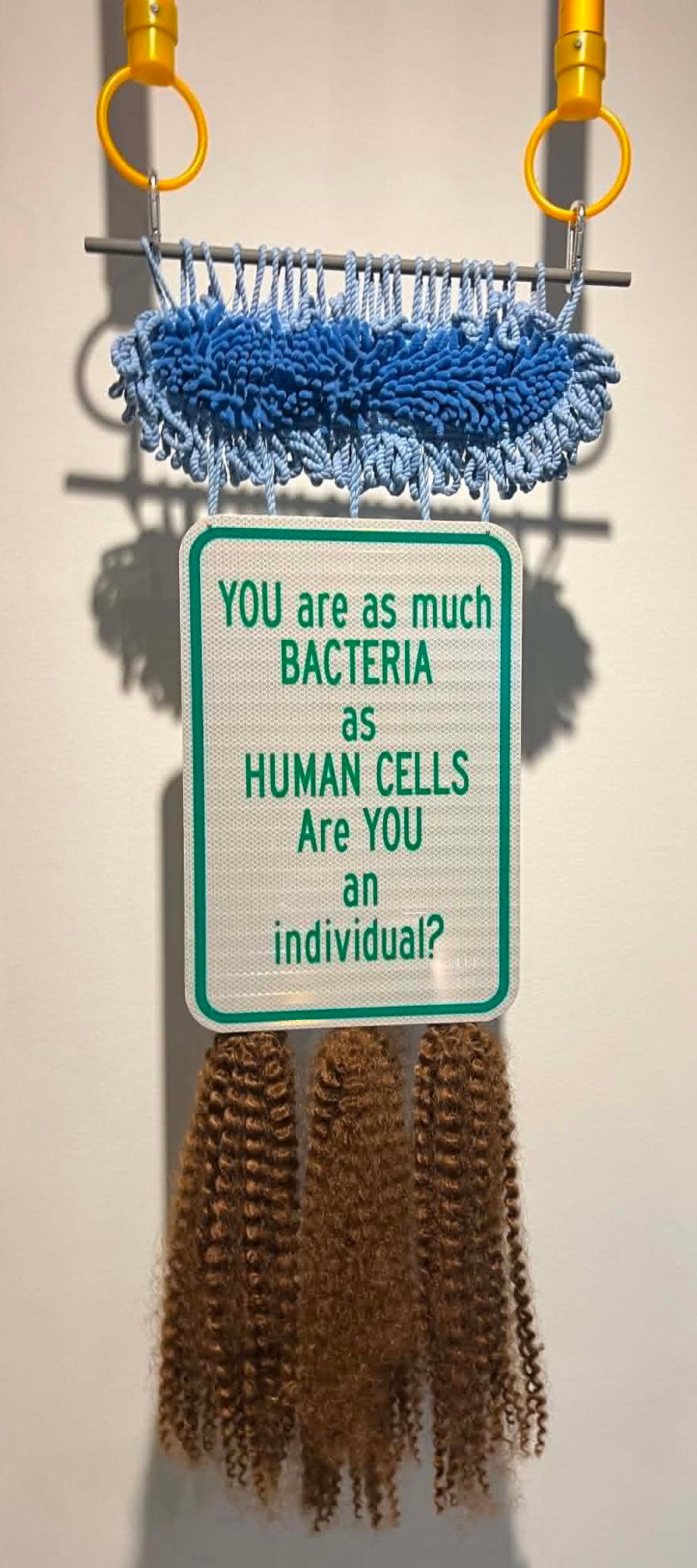
You are as Much Bacteria as Human Cells. Sign
by Ken Rinaldo
Video Courtesy of Ken Rinaldo
Individual works that constitute the complete installation:
1) Sagan Mitochondria: Uses the AI replicated voices of Dr. Lynn Margulis, Dr. Carl Sagan, and Dorion Sagan to tell the story of symbiogenesis; more than two billion years ago, a free-living bacterium entered another cell and, rather than being consumed, became a partner. From this unlikely alliance emerged the mitochondrion, the energy-producing organelle that powers nearly every complex organism on Earth. Forged from atoms born in ancient stars, mitochondria transform energy into life, allowing living systems to create fleeting islands of order within a universe governed by the Second Law of Thermodynamics.
Materials: Hand-blown glass, robotic sensors, Arduino microcontrollers, code, hacked amplified speakers, rapid prototyped domes, and silicon
rubber.
2) Succulent and Cactus Mitochondria: Cacti and succulents owe their resilience to mitochondria, ancient bacterial partners that became permanent residents within plant cells over two billion years ago, providing the energy that fuels life in some of Earth's harshest environments.
Materials: Cactus, succulents, a rapid prototyped lamp, black and pink sand, and monofilament.
3) Moss Mitochondria: Emerging nearly 470 million years ago, mosses were among the first plants to colonize land, helping create soils and ecological conditions that enabled the evolution of all later terrestrial plant life. Chloroplasts convert sunlight into the sugars that build plants, while mitochondria transform those sugars into the energy that powers nearly every living cell.
Materials: moss, rapid prototyped ATP Synthase - 3D model, custom glass, custom lamp, LED backlit monitor, and 200X video microscope.
4) Fern Mitochondria: Emerging over 360 million years ago, ferns flourished through the energy provided by mitochondria. Their immense forests nourished early insects and amphibians, transformed Earth's atmosphere, and left behind soil and coal. Chloroplasts gather sunlight and weave it into living matter, while mitochondria release that stored energy to power life's countless activities.
Materials: Staghorn Fern, Bird's Nest Fern, custom lamp, water heater, bacteria, and custom glass.
5) Cherry Red Shrimp Mitochondria: Descended from ancient freshwater shrimp that drifted through Asian streams and wetlands millions of years ago, Cherry Red Shrimp move like living embers among the water's gardens. They graze upon algae, microbes, and the remnants of fallen plants, transforming decay into life. Within each translucent body, countless mitochondria quietly labor—the descendants of an ancient symbiosis whose energy still fuels every movement, breath, and shimmering passage through the water.
Materials: Cherry Red Shrimp, pumps, stones, Peace Lilly, water, custom lamp, water heater, bacteria, custom glass.
6) Isopod Mitochondria: Emerging on land nearly 300 million years ago, isopods are among Earth's oldest soil engineers. By consuming dead plants and organic debris, they fragment and recycle matter into nutrients that enrich the soil. Their work is fueled by mitochondria, providing the energy for life, decomposition, and regeneration.
Materials: Isopods, custom lamp, temperature and moisture gauge, soil, Demodex Sculpture, plexiglass, custom blown glass, and water.
7) Water Mitochondria: Water is the bloodstream of the living world, carrying nutrients, fueling metabolism, and enabling the invisible chemistry of life. From the first microbes to vast forests and human bodies, all life emerges, persists, and renews itself through water's continuous flow.
Materials: Water, custom lamp, custom blown glass, Raspberry Pi, Sensors, code, hacked amplified speakers, and the sound of water trickling.
8) Human Vortex: Like a whirlpool spiraling through water, life is a fleeting pattern sustained by flow. The vortex appears ordered and enduring, yet it exists only as long as energy moves through it. When the current fades, the form dissolves back into stillness. The Second Law of Thermodynamics tells us that all energy tends toward dispersal, all order toward entropy. Life does not escape this law; it dances within it, creating temporary eddies of complexity—cells, forests, minds, and civilizations—before returning to the wider currents of the cosmos.
Materials: miniature humans, water, rapid-prototyped DNA molecule, rapid-prototyped proteins holding a micro video camera projecting a live feed of spinning humans, plexiglass, Arduino microcontroller, sensors, code, and the sound of distilled water.
9) The Evolution of Information is Life traces the emergence of information from cosmic chemistry and self-organizing molecules to living cells, biological evolution, and artificial intelligence. Through sculpture, sound, and scientific visualization, the work explores how matter, energy, and information become intertwined, generating
increasingly complex systems capable of sensing, learning, remembering, and transforming their environments. The installation proposes that life and intelligence are part of a continuous evolutionary process through which the universe gradually
becomes aware of itself.
Materials: Distilled water, Flashing LEDs, colored sand, rapid-prototyped DNA molecule, speakers, plexiglass, Arduino microcontroller, Sensors, code, custom soundtrack, and a poster featuring an RNA molecule and a filmic sequence of the evolution of our species from a single organism to our post-human selves.
10) You are as Much Bacteria as Human Cells. Sign: You are not solely human. Trillions of bacteria inhabit your body, and their cells rival your own in number and influence. They help digest food, shape immunity, affect mood, and participate in countless processes that sustain life. Rather than a singular being, you are a living ecosystem—a symbiotic gathering of human and microbial lives woven together through deep evolutionary time. Every breath, thought, and movement emerges from this ancient collaboration, a reminder that individuality itself is born from relationship.
Materials: Custom Sign, Human Hair, cone poles.
11) The United Planet, or More-than-Human Others, takes the form of a rocket poised toward the stars, carrying within it the intertwined visions of Carl Sagan and Lynn Margulis. It evokes humanity's longing for celestial exploration, yet peering into its thruster reveals an unexpected voyage inward: a kinesin molecule walking along the cytoskeleton of a living cell, transporting its molecular cargo through an inner universe. The work collapses the vastness of cosmic space and the microscopic depths of biology into a single continuum, suggesting that the same evolutionary forces that gave rise to mitochondria, cells, minds, and technologies now propel us toward other ways of knowing our universe.
Materials: Saturn V Rocket, rebuilt to house a phone with a continues video loop of a 3D animation loop of kinesin motor protein.
12) Printed proteins: A variety of printed proteins.
13) Dorion Sagan Poem and drawing:
(Photo: Fatemeh Baigmoradi)
(Photo: Fatemeh Baigmoradi)
(Photo: Fatemeh Baigmoradi)
(Photo: Fatemeh Baigmoradi)
(Photo: Fatemeh Baigmoradi)
(Photo: Fatemeh Baigmoradi)
(Photo: Fatemeh Baigmoradi)
(Photo: Fatemeh Baigmoradi)
(Photo: Fatemeh Baigmoradi)


Video Courtesy of Ken Rinaldo
Video Courtesy of Ken Rinaldo

Sounds from the Subterrarium by Amy Youngs
Photo Courtesy of Amy Youngs

Video Courtesy of Amy Youngs
Sounds from the Subterrarium, 2024
Amy M. Youngs, in collaboration with David King, Alena Sun, Brian Trelegan
Medium: Installation with live springtails, plants, biochar, bark, coir, worm castings, cork, custom glass, video microscope, fake fur, and computer running custom p5js program.
Using a microscope camera and audio/visualization techniques, we are tracking a population of springtails inside a custom-made terrarium. Springtails are abundant arthropods, found in soils throughout the world. They are important to soil health, as they graze on bacteria and fungi, disperse spores, and keep the nutrients cycling throughout it. To help humans notice their individual interactions, we projected them large and programmed colored dots to indicate their varying speeds. The sounds change based on their movements. Humans can interact with this system by moving the computer mouse to experience an altered soundscape – and perhaps imagine themselves as a tiny cursor in the world of the springtails.
Pheromone Robot Stories, 2010
Ken Rinaldo, Mario Serrano and Seung Hwa Yoon
Medium: 3D Animation
Materials: 3D modeled and rendered worlds. Produced in Cinema 4D.
In a future woven from invisible chemistries, humans, and machines drift toward one another through clouds of scent neither fully understands. Synthetic beings learn to read the silent language of pheromones, transforming desire, attraction, and influence into a new form of communication. The animation unfolds as a speculative ecology in which emotions become signals, bodies become transmitters, and intelligence emerges in the delicate space between biology and code. Through luminous narratives and imagined robotic and human lives, Pheromone Robot Stories asks whether the boundaries between organism and machine are already dissolving. Here, algorithms dream through the chemistry of the flesh, while humans become entangled in networks of invisible persuasion. The work is less a prediction than a meditation on intimacy, evolution, and the unseen forces that shape every encounter between living and artificial beings.

Pheromone Robot Stories by Ken Rinaldo
Video Courtesy of Ken Rinaldo
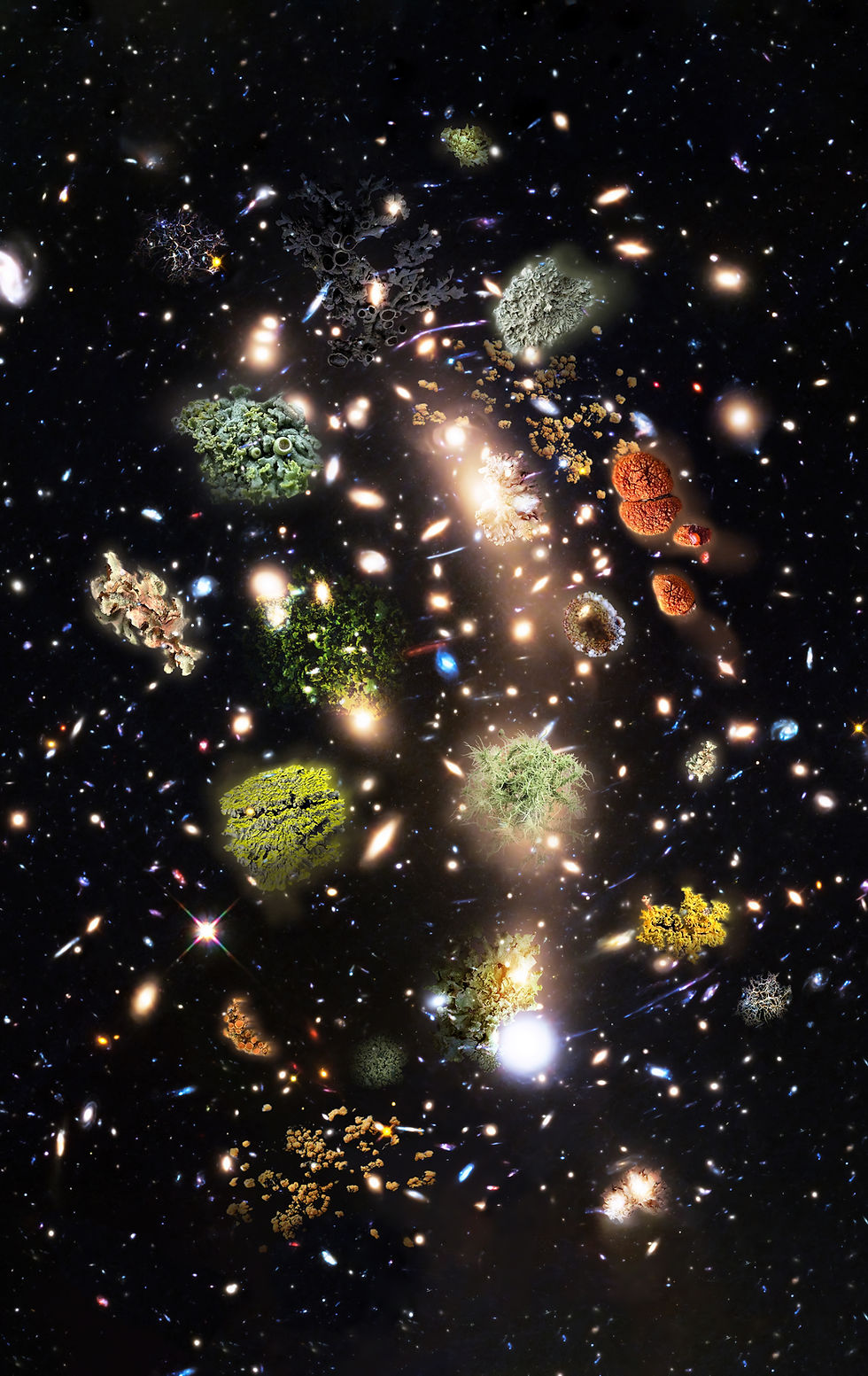
Symbiotic Worldbuilders by Amy Youngs
Image Courtesy of Amy Youngs
Symbiotic Worldbuilders, 2024
Amy M. Youngs
Medium: Ink jet print of digital collage hung with steel and magnets
Lichens are among the most resilient organisms known. They occupy hostile environments, such as urban sidewalks, arctic boulders, desert sands, and the vinyl siding of my garage. They are able to withstand the extremes of outer space, with no air, no water, and high doses of radiation. Their super strengths come from their symbiotic, multi-species association of fungi and photosynthesizing organisms. Together, they build a sustaining world and adapt to the given conditions of the place they find themselves in. Insects, birds, trees, rodents, deer, and humans all benefit from the air, soil, and nutrients that lichens bring to our earth.

Planetary Soil Makers by Amy Youngs
Image Courtesy of Amy Youngs
Planetary Soil Makers, 2026
Amy M. Youngs
Medium: Ink jet print of digital collage hung with steel and magnets
NASA’s Curiosity rover samples the Martian landscape by drilling into rock, while the Perseverance rover has been programmed to search for signs of ancient microbial life on Mars. Perseverance analyzes rocks by zapping them with the Planetary Instrument for X‑ray Lithochemistry (PIXL), which determines their chemical composition and mineral structure.
Earthly lichens also analyze rocks, dissolving them with specialized acids. Before soil or plants existed on Earth, there were only rocks and sunlight, which lichens learned to live on. As they lived and died, lichens played an important role in creating our planet’s first soils, providing the organic material needed for life to take hold. What might happen if lichens could team up with the Mars robots?
Sacs, Membranes, Motors and Vesicles, 2020-2026
Ken Rinaldo
Medium: Hand Drawn works on existing and modified technical machine schematics.
Materials: Pen, metallic inks, Figma permanent Markers, archival paper and overprint processes.
Within these imagined anatomies, membranes unfurl like landscapes and vesicles drift through luminous currents, carrying fragments of memory, energy, and becoming. Organic sacs intertwine with mechanical motors, blurring the distinction between cellular life and engineered systems. Each drawing proposes a speculative ecology where microscopic processes become vast terrains of exchange, cooperation, and transformation.
Sacs, Membranes, Motors, and Vesicles invites us into the hidden choreography that sustains all living things. Here, biological structures and machine architectures mirror one another, revealing life not as an isolated entity but as a network of relationships in perpetual motion. These hybrid forms suggest that evolution itself may be a collaborative act, unfolding through countless acts of symbiosis across bodies, technologies, and time.


Sacs, Membranes, Motors and Vesicles by Ken Rinaldo
Images Courtesy of Ken Rinaldo


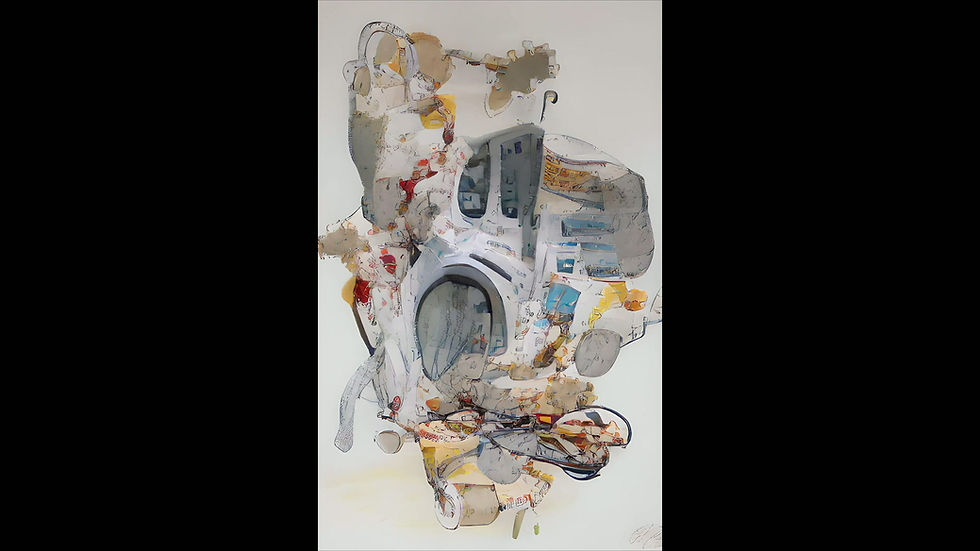
Synthetic Evolution (drawings, prints, and videos), 2024-2026
In association from the Sac Membranes, Motors, and Vesicle drawings.
Ken Rinaldo
Medium: hand-drawn works giving rise to variations on the theme as they were run through AI software. Video: 10-minute videos with AI sound with hand drawn works morphing into AI generative works.
Materials: Giclee Print on LS Cotton radiant white 270 gr paper produced at Centro Portuguese de Serigraphia. Lisbon, Portugal. (Edition 1 of 3).
Synthetic Evolution begins with the intimacy of the hand: drawings made through years of observation, imagination, and embodied mark-making. These forms are then offered to artificial intelligence as seeds, becoming training sets from which new visual organisms emerge. Images mutate, recombine, and proliferate through an exchange between human intuition and machine inference, creating hybrid beings that seem to drift between memory, dream, biology, and code. The work asks what becomes of authorship when creative acts evolve through collaboration with an algorithmic other.
Like a strange digital ecology, the drawings pass through successive generations of transformation, their sacs, membranes, motors, and vesicles reappearing as speculative life forms shaped by both silicon and imagination. In these luminous mutations, the boundary between biological evolution and technological evolution begins to dissolve.
The resulting prints and moving images suggest a future in which human creativity is not replaced by machines but entwined with them—an unfolding symbiosis where ideas replicate, adapt, and evolve at the speed of thought.

Synthetic Evolution by Ken Rinaldo
Photo Courtesy of Ken Rinaldo
Video Courtesy of Ken Rinaldo


Worm Coffee Table, 2026
Amy M. Youngs
Medium: Sculpture with live composting ecosystem, wood stained with worm castings, glass, steel, and potted plant.
Thousands of live worms and billions of microbes inhabit this custom coffee table. Together, they transform household waste – cardboard, wilted lettuce, banana peels, apple cores, dead plants, tea bags and used coffee grounds – into worm castings, a super-enriched compost. As it forms, the castings naturally fall to the bottom of the worm bed and sift down into removable steel coffee filters below.
I think of this furniture as an interface for cohabitation. Living with a household compost ecosystem is a slow, steady way to reconnect one’s sense of self within the larger web of life.

Worm Coffee Table by Amy Youngs
Photos Courtesy of Amy Youngs and Fatemeh Baigmoradi
Synthetic Evolution 2, 2025-2026 (6 wall prints)
Ken Rinaldo
Medium: AI manipulated works from hand-worked collages. the collages were titled: Symbiosis Begins at the Skin, Mouth, Vagina from 2024.
Materials: Giclee Print on radiant white 270 gr paper (Edition 1 of 3).
Synthetic Evolution 2 inhabits the fertile territory between intuition and computation, where hand-drawn forms dissolve into algorithmic dreams. Biomorphic fragments, cellular architectures, and imagined anatomies emerge from vast fields of data, transformed through artificial intelligence into entities that feel at once ancient and unborn. Neither wholly human nor machine-made, these images occupy a threshold space where creativity becomes a shared evolutionary process between biological memory and computational perception.
Like organisms adapting within an unseen ecosystem, the forms continuously mutate, fold, and recombine, revealing a world where imagination itself becomes a living substrate. The work reflects on a moment in which algorithms increasingly participate in how culture is generated, remembered, and transformed. Here, synthetic evolution is not merely a technological process but a poetic condition: a new ecology of images where human desire, machine learning, and the endless capacity of matter to reorganize itself converge into strange and luminous futures.

Synthetic Evolution 2 by Ken Rinaldo
Photo Courtesy of Ken Rinaldo

Visible Pores Portugal by Amy Youngs
Photo Courtesy of Fatemeh Baigmoradi
Visible Pores Portugal, 2022
Amy M. Youngs
Medium: inkjet print of digital collage
Pores are places of passage that are visible in architecture and sometimes visible in the more-than-human life that surrounds and infuses it. The city of Lisbon, Portugal helped me see these connections - with porous limestone streets and the many decorative openings for the passage of liquid, gas, light, electricity, waste, information, plants, people, and other animals.
Focusing on architectural pores drew me closer to organic pores - ant tunnels emerging in the spaces between the cobblestones, tree bark openings that ooze sap, and flowers emitting fragrances to invite insects inside. Still, there is so much happening outside of my limited, human perception.
Organic Murmurations, 2025-2026
Ken Rinaldo
Medium: 3D digital photography manipulated in 3D software; Cinema 4D. Light dark aspects of the photo determined the form.
Materials: Giclee Print on LS Cotton radiant white 270 gr paper produced at Centro Portuguese de Serigraphia. Lisbon Portugal. Edition 1 of 3.
Organic Murmurations transforms photographs of birds, flowers, insects, and living textures gathered in Cholula, Mexico, into luminous digital ecosystems where data behaves like life. Patterns drawn from the natural world are translated into flowing three-dimensional forms, creating imagined habitats that seem to hover between biology and computation. These vibrant swarms of color and structure echo the hidden molecular conversations that animate every living cell, revealing a world where information ripples through matter.
In these colorful landscapes, invisible signals become visible. Light, shadow, and color gather into murmuring constellations of form, suggesting that the same molecular exchanges that shape a feather’s iridescence, a butterfly’s wing, or a flowering plant may also shape entire ecologies. Organic Murmurations invites viewers to contemplate life as an intricate language of chemical relationships—a ceaseless exchange of messages unfolding across scales, from the microscopic to the planetary, where art becomes a bridge between the unseen codes of nature and the imagination.


Organic Murmurations by Ken Rinaldo
Photos Courtesy of Ken Rinaldo